VO₂ Max and Ventilatory Thresholds: How to Build a Smarter Cardio Plan
VO₂ max tells you how large your aerobic engine is. Your ventilatory thresholds show how that engine behaves as the workload rises.
That distinction matters because two people can have similar VO₂ max scores and very different experiences during exercise. One may be able to sustain a relatively high pace before breathing becomes difficult. The other may reach the same aerobic ceiling but begin accumulating physiological strain much earlier.
A useful cardio plan considers both the ceiling and the ranges beneath it. VO₂ max provides the ceiling. The first and second ventilatory thresholds help define where exercise intensity begins to feel and function differently.
Together, these measurements can help answer a more practical question: What kind of cardio training does your body need next?
What does VO₂ max measure?
VO₂ max is the highest rate at which your body can take in, transport, and use oxygen during progressively harder exercise.
It reflects the combined work of several systems:
Your lungs bring oxygen into the body.
Your heart and circulation transport oxygen.
Your blood carries it.
Your working muscles extract and use it to produce energy.
VO₂ max is commonly reported in milliliters of oxygen per kilogram of body weight per minute, written as mL/kg/min. This relative value makes it easier to compare aerobic capacity across people of different body sizes. Absolute oxygen consumption, reported in liters per minute, can provide additional context.
A true VO₂ max technically requires evidence that oxygen consumption has reached a plateau even as the workload continues to increase. That plateau does not appear clearly during every well-performed test. When it does not, the highest measured value may be described more precisely as VO₂ peak.
In fitness settings, “VO₂ max testing” remains the familiar name for the assessment. The important point is that oxygen consumption is measured directly during a graded exercise test rather than estimated from a watch, pace, or questionnaire.
Why VO₂ max matters
VO₂ max is one of the most useful measures of cardiorespiratory fitness. It can help establish an aerobic baseline, compare fitness with appropriate reference values, guide training, and measure change over time.
Cardiorespiratory fitness also belongs in the broader health conversation. A 2024 overview included 26 systematic reviews representing more than 20.9 million observations. Higher cardiorespiratory fitness was consistently associated with lower risk of mortality and several chronic health conditions.
That evidence describes associations across large populations. A VO₂ max score does not diagnose disease or predict an individual lifespan. It does help quantify an important part of physical capacity that routine resting measurements often miss.
The American Heart Association has argued that cardiorespiratory fitness deserves consideration as a clinical vital sign because it adds meaningful information beyond many traditional risk factors.
Still, the peak score is only one part of the test.
What are ventilatory thresholds?
As exercise becomes harder, your muscles require more energy. Oxygen consumption, carbon dioxide production, heart rate, and breathing all rise in response.
Those changes do not remain perfectly linear. At certain intensities, the relationship between breathing and metabolic demand begins to shift. These transition points are called ventilatory thresholds.
During breath-by-breath testing, ventilatory thresholds are identified by examining patterns across oxygen consumption, carbon dioxide production, ventilation, and related respiratory measures. They are not determined from a single breath or one heart-rate reading.
The two thresholds are commonly called VT1 and VT2.
What is VT1?
VT1 is the first ventilatory threshold. It marks the first meaningful change in the breathing response as exercise intensity rises.
Below VT1, exercise is generally more sustainable. Breathing remains controlled, and many people can speak in complete sentences. The body can meet the energy demand with relatively stable aerobic processes.
Near and above VT1, breathing becomes more noticeable and carbohydrate use generally increases. The work may still feel controlled, but it requires a greater share of the available aerobic capacity.
VT1 can be particularly helpful when planning aerobic base work, longer sessions, recovery-oriented exercise, and sustainable weekly training volume.
The talk test can provide a useful field estimate, but it does not locate VT1 with the same precision as respiratory gas analysis. Perceived effort at a measured threshold can also differ considerably between people.
What is VT2?
VT2 is the second ventilatory threshold, often associated with the respiratory compensation point.
At this stage, ventilation rises much more sharply in response to increasing metabolic stress. Breathing becomes deeper and faster, speaking becomes difficult, and the amount of time the effort can be maintained becomes more limited.
VT2 helps identify the upper end of sustained high-intensity work. Training near this threshold may be used to develop the ability to maintain demanding efforts. Work above it is generally performed as intervals because fatigue accumulates quickly.
VT2 should not be treated as a point where the body suddenly changes from aerobic to anaerobic. Energy systems operate together across the entire test. The threshold identifies a meaningful transition in their relative contribution and in the breathing response.
VO₂ max and ventilatory thresholds answer different questions
A simple way to understand the relationship is:
VO₂ max answers: How large is your aerobic capacity?
VT1 answers: Where does easier, sustainable work begin to become more demanding?
VT2 answers: Where does hard work begin to become difficult to sustain?
Threshold placement can be expressed as a heart rate, pace, speed, power output, oxygen-consumption value, or percentage of VO₂ max. Looking at several of those measurements together produces a more useful picture than relying on one number alone.
Consider two people with the same VO₂ max.
One reaches VT1 and VT2 at relatively high percentages of peak capacity. That person can use a substantial portion of the available aerobic ceiling before crossing each transition.
The other reaches both thresholds earlier. The aerobic ceiling may be similar, but the usable range beneath it is organized differently.
Their VO₂ max scores match. Their most productive training priorities may not.
Why percentage-based heart-rate zones can miss the mark
Many cardio plans begin with an age-predicted maximum heart rate and assign zones using fixed percentages.
These formulas can provide a rough starting point when no direct measurement is available. They cannot account for how ventilatory thresholds are positioned in an individual person.
A zone calculated as 70 percent of maximum heart rate might fall below VT1 for one person, close to VT1 for another, and above it for someone else. Research comparing standardized and threshold-based prescriptions has demonstrated meaningful differences in how individuals respond.
Measured thresholds allow heart-rate ranges to be anchored to observed physiological changes during the test. This creates more individualized boundaries for training.
Even measured heart rate requires context. Heat, hydration, sleep, fatigue, medication, emotional stress, and exercise mode can all affect the heart-rate response. A good plan uses heart rate alongside pace or power, breathing, and perceived effort.
Is Zone 2 the same as VT1?
There is no universal definition of Zone 2.
Some systems use three zones. Others use five, six, or seven. A Zone 2 workout in one system may occupy a different physiological range in another.
In many five-zone models, Zone 2 is intended to describe easier aerobic work performed below or around VT1. However, assigning it as a fixed percentage of maximum heart rate can place some people above or well below their actual first threshold.
This explains why two people following the same online Zone 2 formula can have very different training experiences.
Measured VT1 provides an individual reference point. The training target can then be adjusted according to the goal of the session rather than assuming one percentage applies to everyone.
How the different intensity ranges can guide training
Each part of the aerobic range can serve a purpose.
Work below VT1 can support aerobic development, recovery, longer sessions, and the ability to accumulate training volume with a manageable recovery cost.
Work between VT1 and VT2 can develop the ability to sustain more demanding efforts. Depending on the exact intensity and session design, this range may support tempo work, durable endurance, and threshold development.
Work near or above VT2 can provide a strong stimulus for higher-intensity adaptations and improvements in peak aerobic capacity. Because fatigue rises quickly, these efforts are commonly divided into intervals with recovery periods.
The right balance depends on the person’s current physiology, training history, schedule, recovery capacity, exercise preferences, and goals. Every intensity range can be useful when it has a clear job within the larger plan.
What happens during VO₂ max testing at DexaFit Seattle?
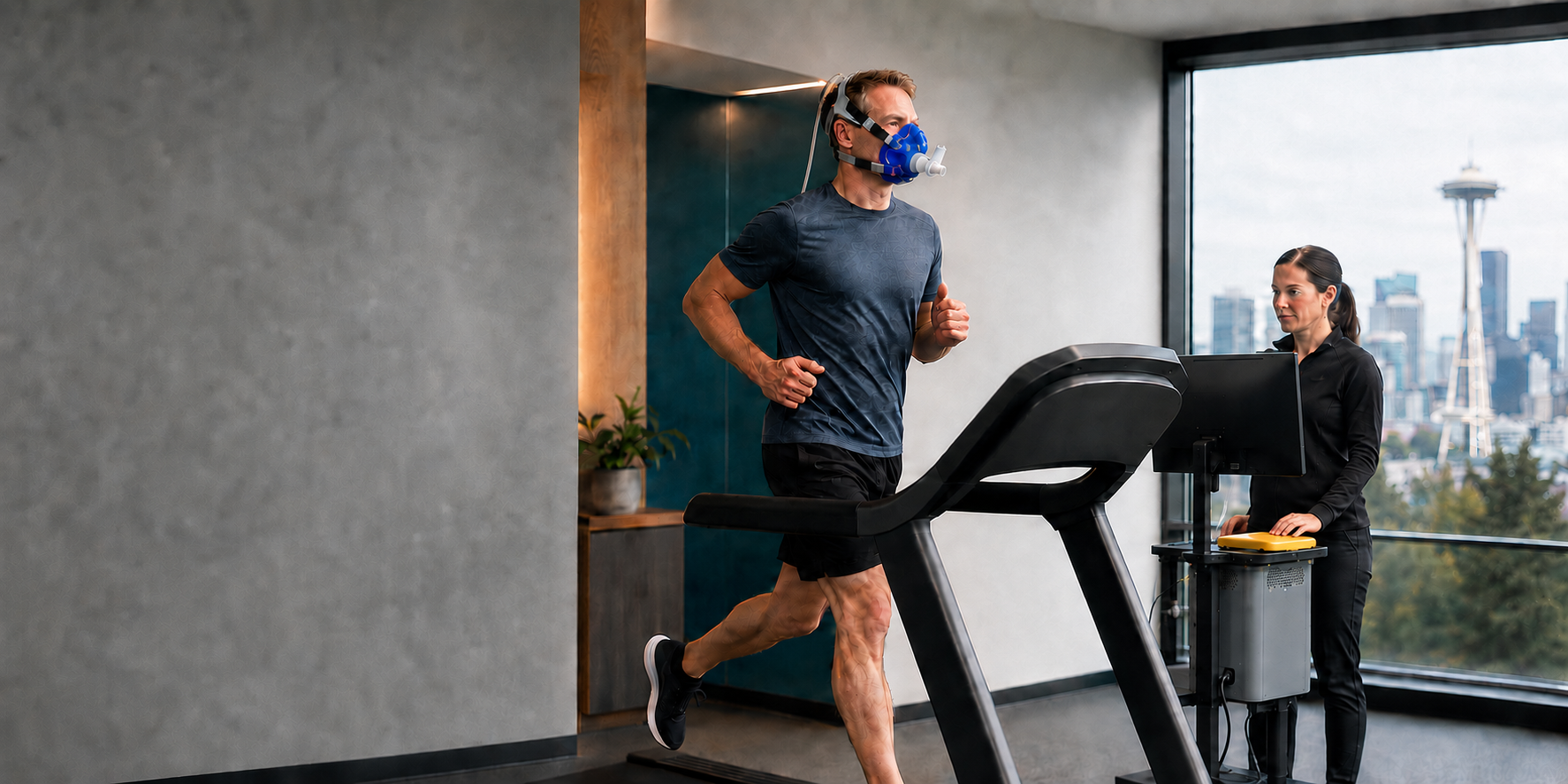
At DexaFit Seattle, VO₂ testing is performed on a treadmill or bike while you wear a mask connected to a metabolic testing system, and a heart rate monitor connected to the metabolic cart.
The system measures oxygen consumption and carbon dioxide production as the exercise demand increases. Rather than relying only on pace and heart rate, we can examine the respiratory response across the entire test.
Protocol selection matters. A useful graded test must increase the workload progressively enough to reveal the ventilatory thresholds and reach a high level of effort without ending too quickly or becoming unnecessarily long.
Our testing team selects the test format according to the client’s current fitness, exercise background, and preferred modality. The active portion of the test typically lasts approximately 7 to 15 minutes, although there may also be “warm up stages” and the complete appointment includes preparation, equipment fitting, recovery, and discussion of the results.
After the test, we review the report with you and explain the major findings. These can include:
VO₂ max or VO₂ peak
VT1 and VT2
Heart rate at each threshold
Individualized training zones
Oxygen consumption across the test
Carbon dioxide production
Changes in ventilation and breathing efficiency
Pace, speed, or power associated with important points
Fuel-use patterns at different intensities
The goal is to help you understand what the measurements mean rather than sending you home with an unexplained score.
Going beyond the standard VO₂ report
A standard VO₂ report can show your peak result, ventilatory thresholds, and heart-rate zones. Those values become more useful when they are interpreted as a connected pattern.
DexaFit Seattle’s Cardio Xone interpretation examines threshold placement, breathing efficiency, heart-rate response, and Miles Per Beat™ together. This helps identify the physiological constraint most likely limiting current aerobic output.
For one person, the priority may be developing the aerobic base below VT1. Another may benefit from improving sustainable output near VT2. Someone with well-developed thresholds relative to a modest peak capacity may need a different stimulus than someone with a high ceiling and comparatively low thresholds.
The interpretation connects the test to three practical decisions:
Where your individual training boundaries are
Which part of your aerobic system deserves attention first
Which cardio methods best match that priority
This keeps the next training block focused. More exercise is not automatically the answer. The useful question is what type of work is most likely to produce the adaptation you need.
How to prepare for a VO₂ max test
Preparation helps make the test safer, more comfortable, and easier to compare later.
DexaFit Seattle currently asks clients to:
Fast for at least three hours before the test and drink only water
Avoid exercise before the appointment
Avoid caffeine and other stimulants on the day of testing
Bring appropriate workout clothing and athletic shoes
Follow any additional instructions included in the appointment confirmation
Arrive well rested and disclose relevant medications, health conditions, recent illness, injuries, or symptoms before beginning.
A fitness VO₂ assessment is not the same as a diagnostic medical stress test. Anyone with unexplained chest discomfort, fainting, unusual shortness of breath, significant cardiovascular or pulmonary disease, or concerns about exercising at high intensity should speak with an appropriate medical professional before testing.
When should you repeat a VO₂ max test?
Retesting is most valuable after enough time has passed for a meaningful adaptation to occur.
For many people, the end of a structured 8-to-12-week training block creates a reasonable opportunity to reassess. The appropriate interval depends on training consistency, goals, baseline fitness, and the size of the expected change.
A follow-up test can show whether:
VO₂ max increased
VT1 or VT2 moved to a higher pace, power, or oxygen demand
Thresholds now occur at different percentages of peak capacity
Heart-rate response changed
Breathing efficiency improved
The intended training priority produced the expected adaptation
Testing too frequently can create more noise than insight. Start with a clear training target, give the plan time to work, and retest when the result could change the next decision.
Frequently asked questions
Is a higher VO₂ max always better?
A higher VO₂ max generally represents greater aerobic capacity, but interpretation should consider age, sex, body size, test mode, training history, and the quality of the test. Performance also depends on thresholds, movement economy, strength, skill, fueling, and other factors.
What is considered a good VO₂ max?
A good result depends on the individual and the reference population. Age- and sex-based percentiles provide more useful context than one universal cutoff. Comparing your result with your own future tests may be even more valuable when the goal is improvement.
Can a smartwatch measure VO₂ max?
Most wearables estimate VO₂ max from combinations of heart rate, pace, movement, and personal information. A laboratory-style test measures respiratory gases during graded exercise. Wearables can be useful for tracking trends, but their estimates are not interchangeable with directly measured oxygen consumption.
Can I determine VT1 with the talk test?
The talk test can offer a practical approximation because speaking usually becomes more difficult as intensity passes the first threshold. Direct gas analysis provides a more individualized measurement and allows the threshold to be interpreted with the rest of the test.
Is VT2 the same as lactate threshold?
The terms are sometimes used interchangeably in fitness discussions, but they describe measurements obtained in different ways. Ventilatory thresholds come from respiratory gas patterns. Lactate thresholds come from changes in blood lactate. They often relate to one another, but they should not automatically be treated as identical.
Are ventilatory thresholds only useful for endurance athletes?
No. Thresholds can help anyone who wants to make cardio training more specific, including recreational exercisers, people preparing for hiking or travel, athletes working toward a race, and adults trying to preserve aerobic capacity as they age.
Does VO₂ testing diagnose heart or lung disease?
A fitness VO₂ test measures exercise physiology and cardiorespiratory capacity. It does not diagnose disease or replace a medically supervised cardiopulmonary exercise test, cardiac stress test, or evaluation by a qualified healthcare professional.
Turn your VO₂ results into a cardio decision
A useful VO₂ test should leave you with more than a ranking.
It should show the size of your aerobic capacity, where your ventilatory thresholds occur, how your breathing and heart-rate responses change as the workload rises, and what those patterns suggest about the next training priority.
At DexaFit Seattle, we perform VO₂ max testing and review the results with you after the assessment. For clients who want a deeper interpretation, Cardio Xone connects the measurements across the test and translates them into individualized zones, priorities, and recommended cardio methods.
Learn more about VO₂ max testing at DexaFit Seattle
Explore the Cardio Xone interpretation