What Does a DEXA Scan Show About Muscle, Fat, and Bone?
The bathroom scale is excellent at answering one question: how much total mass is standing on it today?
That answer can matter. It also combines fat, lean tissue, bone, organs, and water into one number. A 10-pound change can describe several very different outcomes.
A DEXA body-composition scan adds separation. It estimates fat mass, lean soft tissue, and bone mineral content, then maps much of that information by region. Some systems also provide an estimate of visceral adipose tissue.
The result can show whether a body-composition goal is moving in the intended direction and whether another part of the result deserves protection. The scan becomes more useful when you understand both its language and its limits.
The Short Answer
A DEXA body-composition scan can estimate total and regional fat mass, lean soft tissue, and bone mineral content. Depending on the system and report, it may also estimate visceral adipose tissue and provide additional bone-density information.
DEXA does not directly measure skeletal muscle, strength, fitness, or the quality of bone. Hydration, glycogen, preparation, positioning, and differences between scanners can influence comparisons, especially when a reported change is small.
What a DEXA Body-Composition Scan Measures
DEXA stands for dual-energy X-ray absorptiometry. The system passes two low-dose X-ray energy beams through the body. Different tissues attenuate, or weaken, those beams differently. The software uses that information to estimate tissue compartments.
The most common body-composition categories include:
Fat mass: The estimated mass of adipose tissue in the scanned region or whole body.
Lean soft tissue: Non-bone, non-fat tissue. This includes skeletal muscle along with organs, connective tissue, body water, and other lean components.
Bone mineral content: The amount of mineral detected within the scan field.
This separation is the principal advantage over scale weight.
Someone can lose weight while losing a combination of fat and lean tissue. Another person can remain close to the same weight while losing fat and gaining lean soft tissue. The scale compresses both outcomes into one number. DEXA helps separate them.
Does DEXA Measure Muscle?
People often describe DEXA as a test that measures muscle, but the measured category is lean soft tissue.
Skeletal muscle contributes heavily to lean-soft-tissue values, especially in the arms and legs. The category also includes body water, organs, connective tissue, and other non-fat soft tissue. A DEXA result should therefore be described as an estimate of lean soft tissue rather than an exact measurement of contractile muscle.
That distinction becomes especially important when evaluating a small change. Lean-soft-tissue values can move with hydration and glycogen. A higher result after a carbohydrate-loading phase, for example, does not mean all of the difference represents newly built muscle.
DEXA also measures quantity rather than function. It cannot show how much force or power the tissue can produce. Strength, power, balance, and movement skill require their own assessments.
Why Regional DEXA Results Matter
Whole-body totals provide the headline. Regional data can make the report more useful.
A person can lose weight while maintaining lean soft tissue in the legs. Another person can hold total lean soft tissue relatively steady while a regional change appears in one limb. A third may see most of the body-composition change in the trunk.
Those patterns can lead to better questions than total weight alone:
Are both legs changing in a similar way?
Is lean soft tissue being maintained in the region most relevant to the person’s training?
Is most of the fat-mass change occurring in the trunk or elsewhere?
Does an unexpected regional difference agree with injury history or performance data?
Regional results still require context. Positioning affects the boundaries the software uses. Previous injuries, implants, limb differences, recent training, and fluid shifts may influence what appears on the report.
When a regional result looks surprising, ask the testing professional to review scan quality and comparison conditions before building a story around it.
Fat Mass Tells a Different Story Than Scale Weight
Scale weight can rise while fat mass falls if lean tissue, glycogen, and water increase. It can also fall quickly during a low-carbohydrate week even when the change in stored body fat is modest.
DEXA gives fat mass its own line on the report, making longer-term comparisons more informative. For weight-loss monitoring, the most useful question often concerns the composition of the change: how much came from fat mass, and what happened to lean soft tissue during the same period?
A 2025 systematic review and meta-analysis examined 25 studies involving adults with overweight or obesity who were participating in dietary weight-loss interventions. Adding resistance exercise did not produce a significantly different change in total body weight compared with diet alone. It was associated with better preservation of fat-free mass, greater fat-mass loss, and improved strength.
That helps explain how two people can lose the same number of pounds and produce different outcomes. DEXA can measure part of that story. Training records, strength measures, recovery, and clinical context add the rest.
Does DEXA Show Visceral Fat?
At DexaFit Seattle, our GE Lunar system provides a CoreScan estimate of visceral adipose tissue, commonly abbreviated as VAT. This measurement is included in our body-composition reporting.
Visceral fat is located within the abdominal cavity around the internal organs. It is different from the subcutaneous fat stored beneath the skin. A VAT estimate can add context to changes in the central region and help distinguish those changes from total body-fat percentage alone.
The wording matters here too: this is an estimate generated by the system rather than a direct view of every fat deposit around the organs.
CoreScan is not an arbitrary calculation. GE’s method has been validated against computed tomography, or CT, and demonstrated strong agreement within the populations studied. Research has also found good measurement precision, although individual error and limitations remain, particularly at very low visceral-fat levels and outside the populations in which the software was validated.
We interpret the VAT estimate alongside the rest of the DEXA report and encourage clients to consider it with blood pressure, laboratory markers, medical history, symptoms, and other relevant health information.
A DEXA visceral-fat estimate does not diagnose a medical condition or replace clinical evaluation.
Bone Information Needs the Right Context
DEXA technology is also used for bone-mineral-density testing. This is where several different types of scans are easy to blur together.
A whole-body body-composition scan may report bone mineral content and whole-body bone-density information. Clinical osteoporosis assessment generally relies on bone-mineral-density measurements at validated skeletal sites, commonly the lumbar spine and hip, together with age-appropriate scoring, clinical risk factors, scan quality, and professional interpretation.
A total-body result should not be treated as interchangeable with a site-specific central DXA study.
The International Society for Clinical Densitometry provides detailed guidance about which skeletal sites should be measured and how the findings should be acquired, scored, and interpreted. Age, sex, menopausal status, medications, previous fractures, health conditions, and other clinical risk factors can all influence the medical conversation.
This distinction protects the value of both types of testing. A body-composition scan can make bone visible within a broader physical-capacity discussion, while site-specific testing is used when the question centers on bone mineral density at a particular region.
A licensed clinician can determine whether a finding calls for further diagnostic testing, medical evaluation, or a change in care.
Questions about osteoporosis, fracture risk, treatment, or an unexpected bone-density finding belong with the appropriate healthcare professional.
Why DEXA Preparation Affects the Comparison
DEXA is often praised for precision, but precision does not make biology stand still.
Lean soft tissue contains a large amount of water. Glycogen stored in muscle is also associated with water. Research involving exercise-induced dehydration followed by glycogen supercompensation found substantial apparent changes in DEXA lean-tissue measurements without corresponding changes in fat mass or bone mineral content.
A hard training session can alter fluid distribution. A very different carbohydrate or sodium intake can change the state in which the body arrives at the scanner. Food in the digestive tract and bladder contents can also affect total mass and regional measurements.
When possible, keep these conditions similar between scans:
Time of day and recent food intake
Hydration and recent alcohol intake
Recent strenuous exercise
Clothing and metal removal
Scanner, positioning, and analysis method
The goal is not to manufacture a better-looking result or demand a perfectly identical day. It is to bring the body to each scan under reasonably comparable conditions so hydration, glycogen, food, and recent training are less likely to obscure the change the client is trying to measure.
Professional guidance also emphasizes local quality-control practices, consistent positioning, and care when comparing results across manufacturers or systems. Results from different machines may not provide a clean one-to-one comparison, especially when the apparent changes are small.
How DEXA Is Performed at DexaFit Seattle
Understanding what DEXA measures is one part of choosing where to be tested. The people operating the equipment, the preparation and positioning protocols, the testing environment, and the explanation afterward all affect how useful the result becomes.
DexaFit Seattle is owned and operated by registered radiologic technologists with more than 30 years of experience in the medical field. The owners have developed DEXA positioning and technologist-training protocols that are used by DexaFit locations across the country.
Every member of our testing staff is certified to perform DEXA scans and completes intensive training led by our radiologic-technologist owners. That training covers client preparation, consistent positioning, scan acquisition, quality review, analysis, and clear explanation of the report.
Before the appointment, clients receive preparation instructions designed to reduce avoidable variability. These include arriving appropriately fasted, maintaining normal hydration, avoiding glycogen-depleting or unusually strenuous workouts during the preceding 24 hours, and following our guidance about alcohol, clothing, metal, and other factors that could affect the scan.
The scanner itself also matters. DEXA systems are large radiologic instruments that must be installed on a suitable surface, carefully leveled, commissioned, maintained, and monitored through appropriate quality-control procedures.
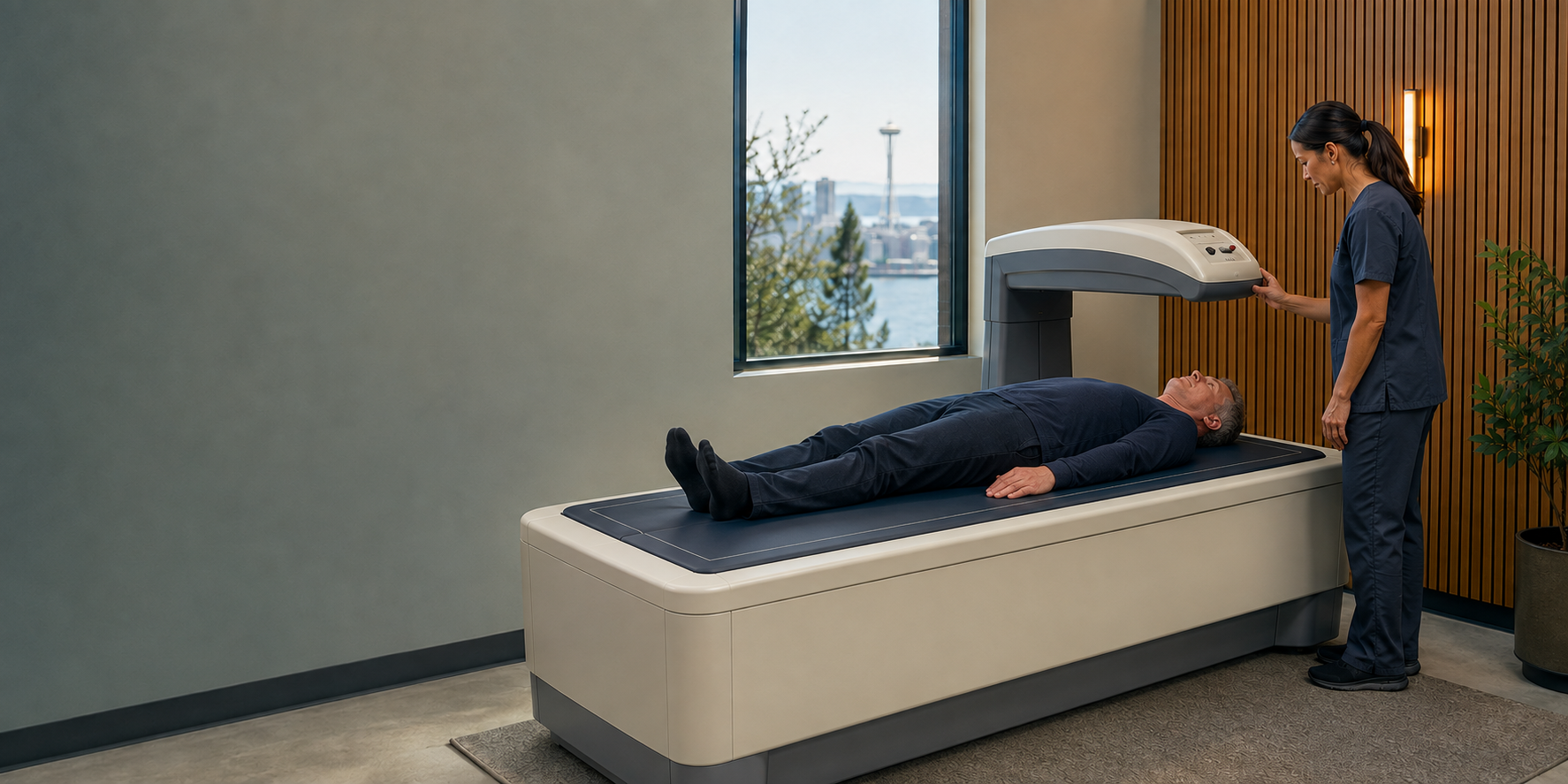
Our GE Lunar scanner is permanently installed at our Seattle location and was professionally leveled and commissioned for that environment. Keeping it stationary avoids additional variables associated with repeated transport, vibration, changing floor conditions, and changing environmental conditions.
A stationary scanner does not guarantee a good result by itself. The equipment, quality-control process, preparation, positioning, acquisition, and analysis all contribute to repeatability.
Anyone comparing DEXA providers should ask who performs and reviews the scan, how clients are positioned, how quality control is handled, whether the scanner is permanently installed, and whether future scans can use the same system and protocol.
Every DexaFit Seattle DEXA appointment includes a personal review of the results. We explain fat mass, lean soft tissue, regional findings, the CoreScan visceral-fat estimate, and the difference between whole-body bone information and site-specific bone-density testing.
We also offer site-specific bone-density scans for clients whose question requires assessment at established skeletal sites.
Results are delivered through the DexaFit AI app as well. The app adds expanded explanations, trend tracking, additional calculations, and proprietary metrics that are not included in a basic manufacturer report.
During the review, we distinguish measured values from estimates, calculations, and proprietary metrics so clients understand what each result represents.
When the question extends beyond tissue quantity, DEXA can be paired with Proteus power testing. DEXA estimates how much lean soft tissue is present and where it is distributed. Proteus measures force, velocity, and power during selected movement patterns.
Together, they provide information about both the amount of lean tissue and the physical output associated with it.
What a Follow-Up DEXA Scan Can Clarify
A first scan establishes a baseline. A follow-up scan can show what changed during a defined period of training, nutrition, or weight management.
The timing should match the question. Daily and weekly retesting would largely capture measurement noise and short-term biological changes. A longer interval gives the intended adaptation time to develop.
For many people following a structured program, approximately 12 to 16 weeks provides a useful comparison window, although the appropriate timing depends on the goal, expected rate of change, testing protocol, and decision the result will inform.
Before scheduling a follow-up, write down the question you want the comparison to answer. Examples include:
Did fat mass decrease while lean soft tissue remained reasonably stable?
Did a resistance-training block change regional lean soft tissue in a way that agrees with strength and training data?
Did a period of intentional weight gain produce the body-composition change the person wanted?
Did the visceral-fat estimate move in the intended direction?
Does a bone-related result need review by a licensed clinician?
When a change is small, review preparation, positioning, and the facility’s precision practices. One tiny movement should not carry the weight of an entire program decision.
Confidence grows when comparable conditions, the size of the change, and related outcomes point in the same direction.
Five Questions Worth Asking About Your DEXA Report
1. What changed in fat mass?
Look at the whole-body amount and relevant regional patterns. Compare the result with the goal and the time between scans.
2. What changed in lean soft tissue?
Review both total and regional values. Ask whether preparation or a substantial difference in hydration or glycogen could have influenced a small movement.
3. Does the report include a visceral-fat estimate?
If it does, ask how the estimate is generated and how it should be compared over time. Keep it within the broader health picture.
4. What bone information is present?
Clarify whether you received whole-body bone information, a site-specific central BMD study, or another type of result. Ask which questions belong with your healthcare provider.
5. What decision will this result change?
The scan may support continuing the current approach, reviewing one part of the plan, or gathering another measurement. A useful report gives the next review a clearer purpose.
What a DEXA Scan Cannot Tell You
DEXA cannot explain every cause behind a body-composition change. It does not measure the quality of a diet, the execution of a training program, or the reason a person feels fatigued.
It also does not measure:
Cardiovascular fitness or ventilatory thresholds
Resting or total daily energy expenditure
Strength or power
Balance or movement quality
Blood pressure or laboratory markers
The causes of symptoms or changes in health
Those limits keep the report honest. They also identify where another measurement may add value.
RMR can measure resting energy expenditure under controlled conditions. VO2 testing can measure aerobic capacity and ventilatory thresholds. Strength and movement testing can evaluate additional aspects of physical function. Medical testing and professional assessment can address clinical questions.
Pairing DEXA with Proteus power testing can help distinguish between having relatively little lean tissue, having adequate lean tissue that is not producing the expected output, and possessing both tissue and performance capacity.
Training history, pain, injury, balance, movement quality, and technique still require their own consideration.
For a fuller explanation of how these measurements fit together, read DEXA, RMR and VO2 Max: What These Tests Tell You About Your Body.
Build the Frame for What Happens Next
Muscle and bone deserve attention because they support what you want your body to keep doing. A DEXA scan provides a clearer view of the material being carried into that work.
Use the result to choose one 90-day outcome and one measurement you want to protect. Fat loss may be paired with lean-soft-tissue monitoring. A strength phase may use DEXA as one body-composition checkpoint while performance is measured separately. A bone result may prompt a conversation with a licensed clinician before the next step is set.
The free 90-Day Reserve Plan helps organize those questions before the work begins.
Open the Free 90-Day Reserve Plan
For a measured starting point across body composition, resting energy expenditure, and aerobic capacity, DexaFit Seattle offers coordinated DEXA, RMR, and VO2 testing at our Lower Queen Anne location.
DEXA can also be paired with Proteus when the question includes the power produced by that lean tissue.
Explore Testing and Book an Appointment at DexaFit Seattle
Frequently Asked Questions
What does a DEXA body-composition scan show?
A DEXA body-composition scan estimates total and regional fat mass, lean soft tissue, and bone mineral content. Depending on the system, the report may also include a visceral-fat estimate and additional bone-density information.
Does DEXA measure muscle directly?
No. DEXA measures lean soft tissue, which includes skeletal muscle as well as body water, organs, connective tissue, and other non-fat soft tissue.
Regional lean-soft-tissue measurements can provide useful context about muscle, but they are not a direct measurement of contractile muscle or strength.
Can hydration affect DEXA lean-mass results?
Yes. Hydration, glycogen, food intake, recent exercise, and related fluid shifts can affect lean-soft-tissue measurements. Comparable preparation is especially important when interpreting small changes between scans.
Can a whole-body DEXA scan diagnose osteoporosis?
A whole-body body-composition scan should not be treated as interchangeable with a site-specific central bone-density study.
Osteoporosis evaluation generally uses validated skeletal sites such as the hip and lumbar spine, together with appropriate scoring, medical history, risk factors, and clinical interpretation.
Does DEXA measure visceral fat?
Yes. DexaFit Seattle’s GE Lunar system uses CoreScan software to estimate visceral adipose tissue within the abdominal region.
CoreScan has been validated against CT and provides useful additional context, but it does not replace medical evaluation, bloodwork, or other cardiometabolic risk information.
Who performs DEXA scans at DexaFit Seattle?
DexaFit Seattle is owned and operated by registered radiologic technologists with more than 30 years of medical-field experience.
Every staff member is certified to perform DEXA scans and completes intensive owner-led training in preparation, positioning, scan acquisition, quality review, analysis, and report explanation.
Will someone explain my DEXA results?
Yes. Every DexaFit Seattle appointment includes a personal review of the report.
We explain fat mass, lean soft tissue, regional composition, visceral fat, and available bone information, along with the limits of each measurement and the questions that may require another assessment or healthcare professional.
Does DexaFit Seattle offer site-specific bone-density testing?
Yes. We offer site-specific bone-density testing in addition to the bone information available from a whole-body body-composition scan.
During the results review, we explain the difference between the two and the role of appropriate clinical interpretation.
Can DEXA be combined with power testing?
Yes. DexaFit Seattle can pair DEXA with Proteus power testing.
DEXA estimates the amount and distribution of lean soft tissue, while Proteus measures force, velocity, and power during selected movements. Together, they provide information about both tissue quantity and physical output.
How often should you repeat a DEXA body-composition scan?
Retesting is most useful after enough time has passed for a meaningful change and when the result could affect a decision.
For many people following a structured nutrition or training program, approximately 12 to 16 weeks is a practical interval. The right timing depends on the goal and expected rate of change.
Sources
International Society for Clinical Densitometry: Official Adult Positions
Ergun et al.: Visceral Adipose Tissue Quantification Using Lunar Prodigy