DEXA, RMR and VO2 Max: What These Tests Tell You About Your Body
Body composition, metabolism, and cardiovascular fitness answer very different questions. Here is what we learn when we measure all three.
You can know your weight to the tenth of a pound, your resting heart rate, last night’s sleep score, yesterday’s calorie intake, and how many steps you took before lunch and still have no idea whether your training and nutrition are actually changing the things that matter.
That is because most health metrics answer only one question.
A bathroom scale tells you how heavy you are. It cannot tell you what that weight is made of. A smartwatch can estimate calorie expenditure and track heart rate, but it cannot measure your resting metabolism or tell you exactly where your aerobic thresholds occur. Bloodwork can reveal important information about what is circulating in your body, but it does not tell you how much muscle you carry or how efficiently you use oxygen during exercise.
At DexaFit Seattle, my wife and I have spent the past decade performing and interpreting thousands of DEXA, RMR, and VO2 Max tests. Between us, we bring more than 50 years of combined medical-practitioner experience to that work.
One thing we have seen repeatedly is that the number someone is most concerned about when they walk through the door is not always the number that matters most once we see the whole picture.
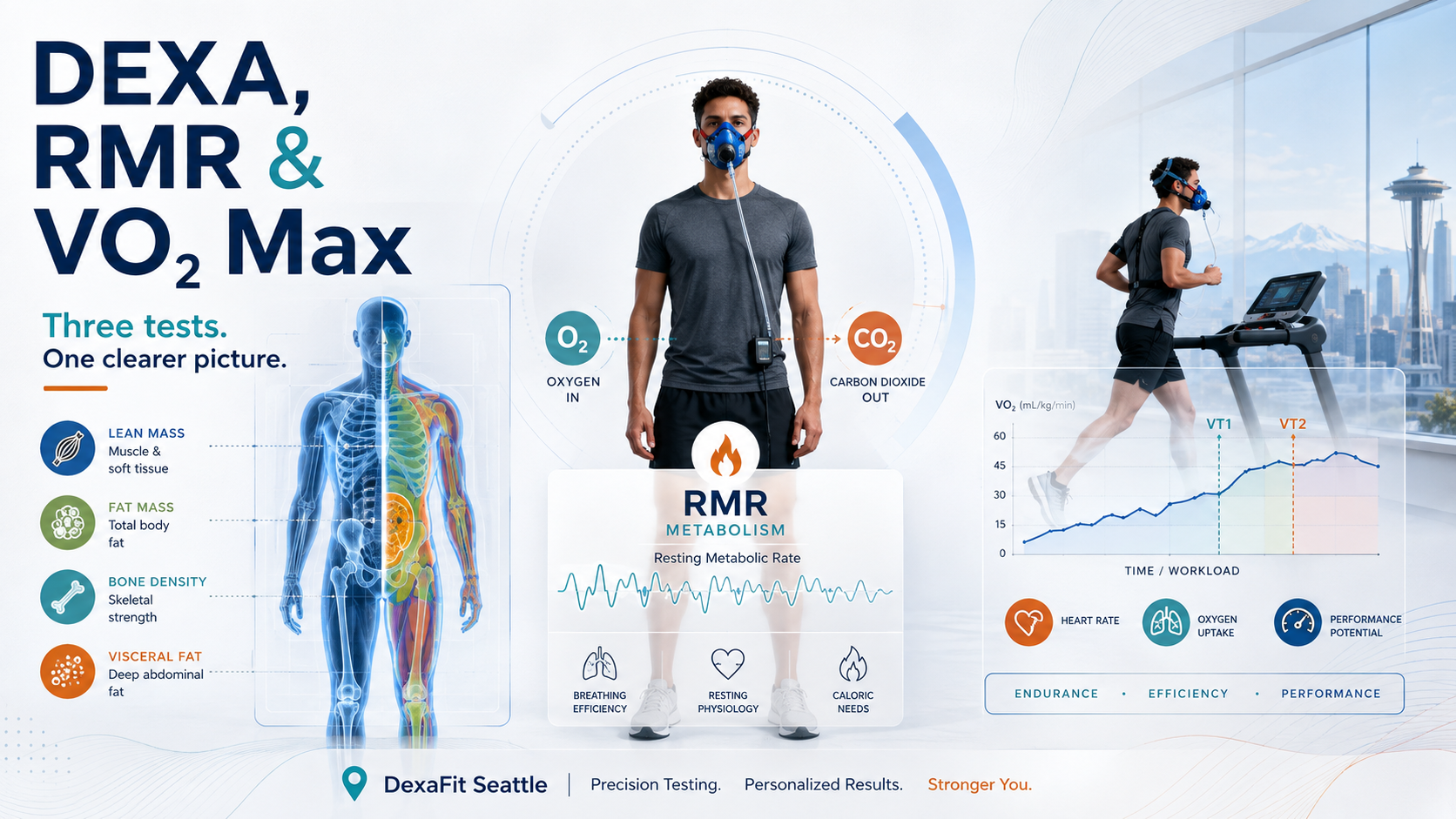
That is where combining DEXA body composition, Resting Metabolic Rate, and VO2 Max testing becomes particularly useful.
Each test looks at a different part of your physiology:
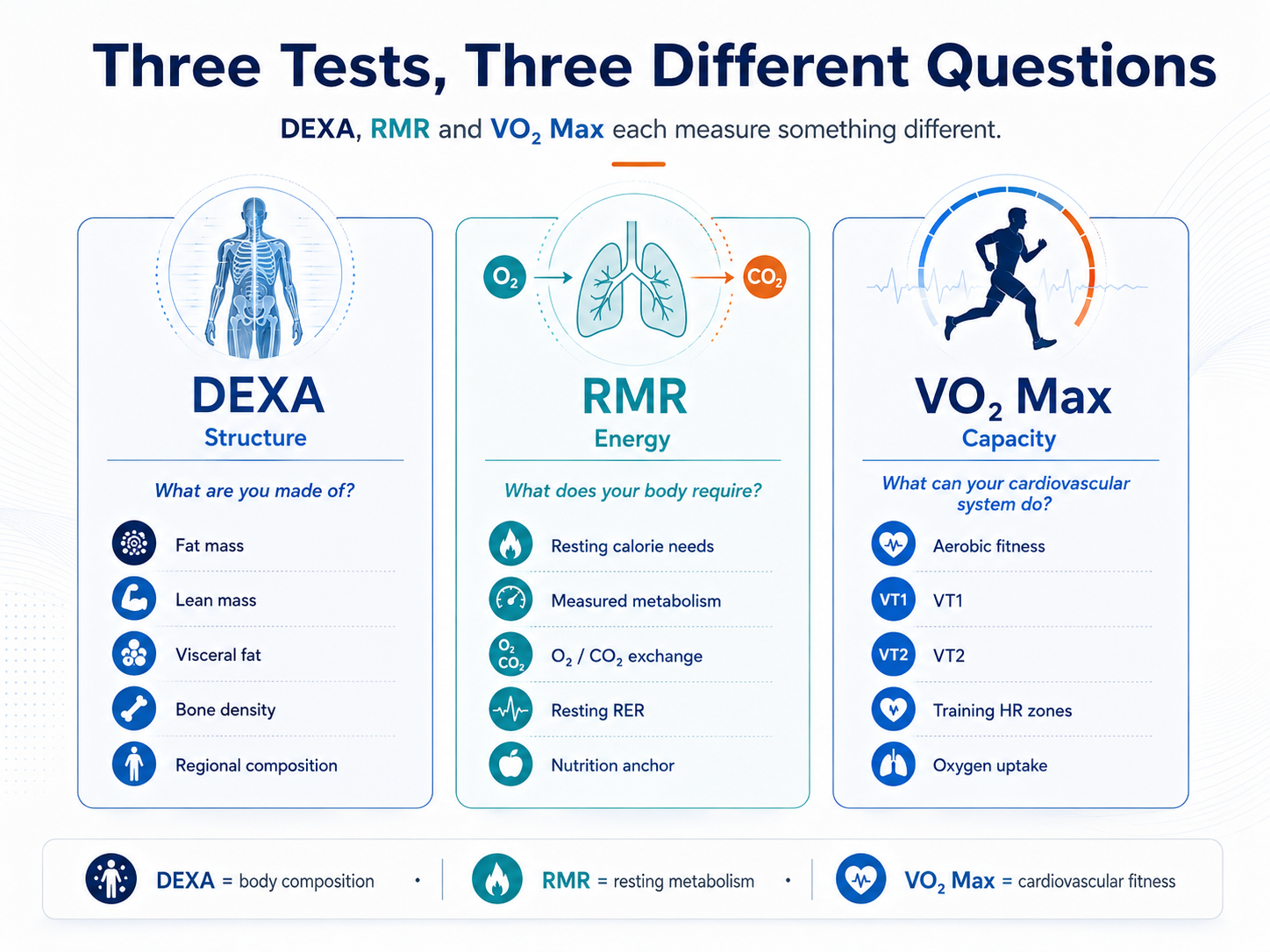
DEXA asks: What is your body made of?
RMR asks: How much energy does your body require at rest?
VO2 Max asks: How well can your cardiovascular system deliver and use oxygen?
Individually, each test is valuable. Together, they can tell a much more useful story.
DEXA: What Is Your Body Actually Made Of?
A DEXA scan, short for Dual-Energy X-ray Absorptiometry, uses two low-dose X-ray energies to estimate bone mineral content, fat mass, and lean soft tissue throughout the body.
Unlike a scale, DEXA can show you where those tissues are distributed.
That matters because losing ten pounds is not automatically good news, just as gaining three pounds is not automatically bad news.
If you lose ten pounds, how much came from body fat?
Did you preserve your lean mass?
Did you lose muscle while dieting?
Did your visceral fat decrease?
If the scale did not change at all, is it possible that you lost fat while gaining lean tissue?
A standard scale cannot answer any of those questions.
DEXA can.
What DEXA Can Tell You
A DEXA body-composition assessment can provide information about:
Total body-fat percentage
Total fat mass
Total lean mass
Regional lean mass in the arms, legs, and trunk
Regional fat distribution
Visceral adipose tissue
Bone mineral density
Differences in lean mass between the left and right sides of the body
One particularly useful measurement is visceral adipose tissue, or VAT.
Visceral fat is stored deeper in the abdominal cavity around the organs and has a stronger relationship with cardiometabolic risk than simply knowing your total body-fat percentage.
DEXA can estimate this visceral fat separately from the subcutaneous fat stored beneath the skin.
It can also reveal differences in lean mass between the left and right sides of the body. Those differences do not automatically mean that something is wrong, but they can provide useful context when evaluating training history, previous injuries, rehabilitation, or strength imbalances.
The Scale Can Hide Successful Progress
One of the most common situations we see is someone becoming frustrated because their scale weight has barely changed.
Then we perform another DEXA.
They may have lost several pounds of fat while gaining lean mass.
The scale says, “Nothing happened.”
Their physiology says otherwise.
This is one reason body composition is usually more useful than body weight alone when evaluating whether a training or nutrition strategy is working.
RMR: How Much Energy Does Your Body Require at Rest?
Your Resting Metabolic Rate, or RMR, is the amount of energy your body uses simply to keep you alive at rest.
Even if you stayed in bed all day, your body would still require energy to maintain your brain, heart, lungs, nervous system, circulation, cellular repair, and countless other physiological processes.
That baseline energy requirement is your RMR.
Estimated Metabolism vs. Measured Metabolism
Most calorie calculators and nutrition apps do not actually measure your metabolism.
They estimate it.
These calculations typically use factors such as:
Age
Sex
Height
Weight
Sometimes estimated or measured lean mass
Population equations can be useful starting points, but people are not population averages.
Two people of similar height, weight, age, and sex can have meaningfully different resting metabolic rates.
For some individuals, the difference between a prediction equation and a measured RMR can amount to several hundred calories per day.
That becomes important when someone is trying to determine how much they should eat to lose fat, maintain their weight, support training, or gain muscle.
How RMR Is Measured
At DexaFit Seattle, RMR is measured using indirect calorimetry.
Instead of predicting your metabolism from an equation, indirect calorimetry measures the oxygen you consume and the carbon dioxide you produce while resting.
Those gases allow us to calculate your actual energy expenditure during the test.
The result gives us a measured metabolic baseline that can be used when building a nutrition strategy.
RMR testing can also provide your respiratory exchange ratio, or RER, which gives additional information about the mixture of carbohydrate and fat being used for energy at rest.
RMR does not tell us everything about your daily calorie expenditure. You still burn additional energy through movement, exercise, digestion, and everyday activity.
But it gives us something extremely useful:
A measured starting point instead of another prediction.
VO2 Max: How Well Can Your Body Deliver and Use Oxygen?
VO2 Max measures the maximum amount of oxygen your body can take in, transport, and use during increasingly difficult exercise.
This involves several systems working together.
Your lungs need to bring oxygen into the body.
Your heart has to pump oxygenated blood.
Your blood vessels have to deliver it.
And your muscles need to extract and use that oxygen to produce energy.
VO2 Max gives us a window into how well that entire system performs.
VO2 Max Is More Than an Athletic Metric
People often associate VO2 Max with cyclists, runners, and endurance athletes.
It certainly matters for performance.
But cardiovascular fitness is also strongly associated with long-term health.
Cardiorespiratory fitness has become such an important health marker that the American Heart Association has argued for its consideration as a clinical vital sign.
That means VO2 Max testing is not simply about seeing how fast you can run.
It tells us something important about the capacity of your cardiovascular system.
The Most Useful Information May Not Be the VO2 Max Number
The headline number gets most of the attention, but one of the most practically useful parts of a VO2 assessment is identifying your ventilatory thresholds.
These thresholds tell us how your physiology changes as exercise intensity increases.
Ventilatory Threshold 1: VT1
VT1 is the first clear change in the relationship between ventilation and oxygen consumption as exercise intensity rises.
Below and around VT1, exercise can generally be sustained for long periods.
This makes VT1 particularly useful for establishing lower-intensity aerobic training and helping define an individualized Zone 2 range.
Ventilatory Threshold 2: VT2
VT2 occurs at a considerably higher intensity.
At this point, breathing begins increasing much more rapidly as the body responds to the growing metabolic demands of hard exercise.
Work above VT2 becomes increasingly difficult to sustain.
Knowing the heart rate and workload associated with VT1 and VT2 gives you individualized training anchors instead of relying entirely on formulas such as “220 minus your age” or generic percentage-based heart-rate zones.
For someone who trains regularly, that can be more useful than the VO2 Max score itself.
Why the Tests Are More Useful Together
The easiest way to understand the relationship between these tests is to think of them as three different views of the same person.
DEXA: Structure
What are you made of?
Fat mass, lean mass, visceral fat, bone density, and regional composition.
RMR: Energy
What does your body require?
Measured resting energy expenditure and resting fuel utilization.
VO2 Max: Capacity
What can your cardiovascular system do?
Aerobic fitness, ventilatory thresholds, and individualized training intensities.
None of these replaces the others.
A person can have an excellent body composition and poor cardiovascular fitness.
Someone can have a high VO2 Max while losing too much lean tissue during a diet.
Someone can train consistently yet struggle with nutrition because their calorie target was built around a metabolic estimate that does not fit them particularly well.
After thousands of assessments, this is where we see testing become the most useful:
One result often changes how we interpret another.
What Combining the Tests Can Reveal
Consider a few examples.
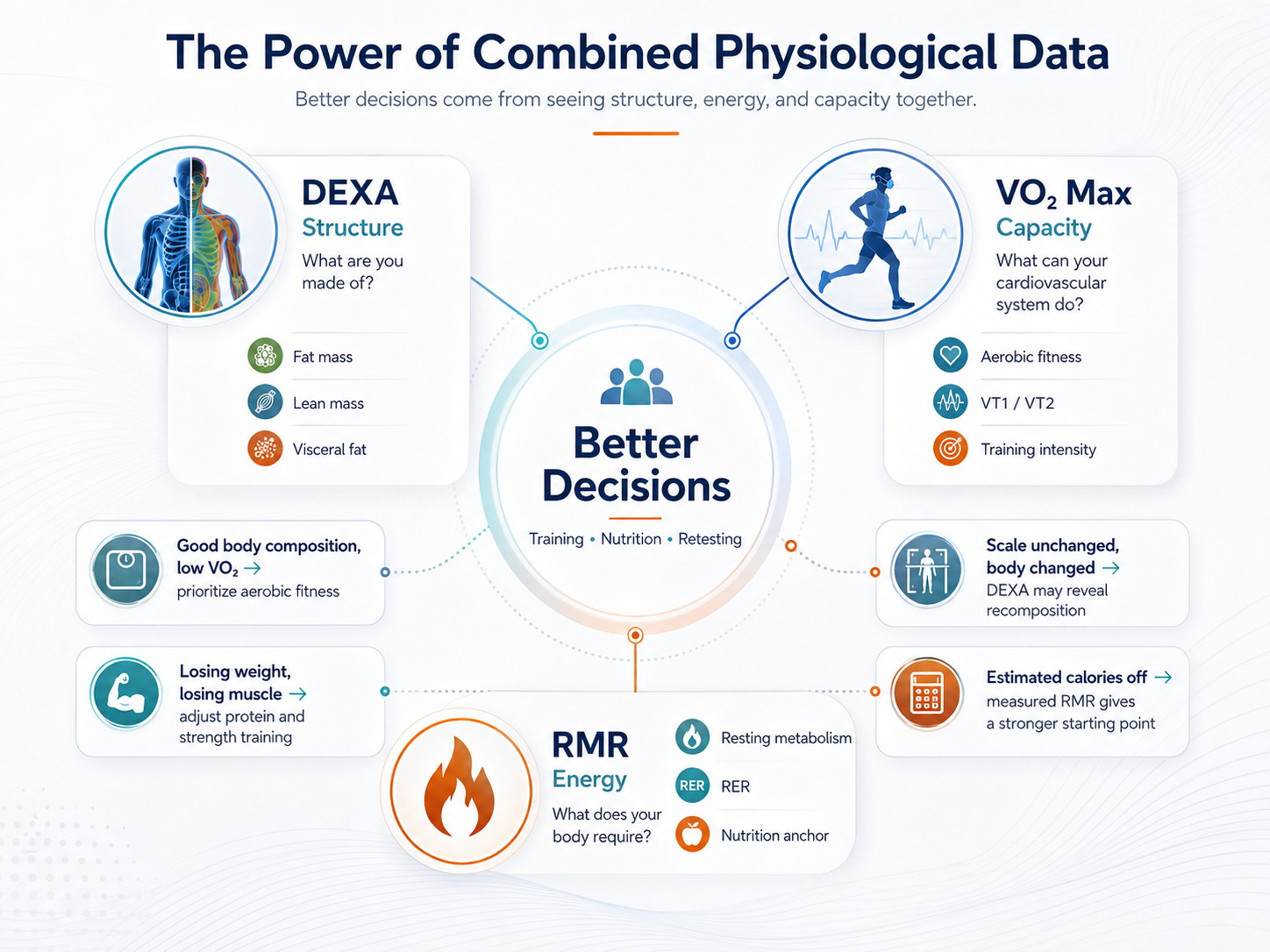
Scenario 1: Healthy Body Composition, Low Cardiovascular Fitness
DEXA shows low visceral fat, good lean mass, and a healthy body-fat level.
The person assumes everything looks great.
Then VO2 testing shows that their cardiorespiratory fitness is considerably below where we would expect it to be.
The priority may not be losing more weight.
The bigger opportunity may be improving aerobic fitness.
Scenario 2: Losing Weight and Losing Too Much Muscle
Someone begins a fat-loss program and the scale is moving exactly as hoped.
VO2 Max is improving.
Everything appears successful.
But follow-up DEXA shows that a meaningful portion of the weight loss is coming from lean mass.
That changes the conversation.
Protein intake, calorie deficit, recovery, and resistance training may need to be adjusted so fat loss can continue without unnecessarily sacrificing lean tissue.
Scenario 3: The Scale Says Nothing Is Happening
Someone has been training consistently for three months.
Their scale weight barely changes.
They assume the program failed.
Follow-up DEXA shows several pounds of fat loss along with an increase in lean mass.
Their body changed substantially.
The scale simply could not see it.
Scenario 4: Nutrition Built Around the Wrong Starting Number
An active person is eating according to a calorie calculator but repeatedly feels that their intake does not match their training or results.
RMR testing reveals that their measured resting metabolism differs meaningfully from the estimate they were using.
That does not magically give us a perfect daily calorie target.
It does give us a better starting point.
And better starting information usually leads to better decisions.
Going Beyond the Test
A DEXA scan, RMR test, or VO2 Max assessment can give you excellent measurements.
But a report full of measurements still leaves one important question:
What should I actually do with this information?
That is the reason we created Beyond the Test at DexaFit Seattle.
Our goal is not simply to perform testing and hand you a set of numbers. We use the data to build a deeper picture of your physiology, identify the areas that deserve the most attention, and translate those findings into practical decisions about training, nutrition, and future testing.
Depending on your testing and goals, Beyond the Test can include:
Structural & Physique Interpretation
We look beyond body-fat percentage to examine lean mass, visceral fat, regional composition, asymmetries, strength and power, movement quality, and other structural findings. The goal is to identify the most important opportunities and limitations rather than simply telling you whether a number falls inside a reference range.
Cardio Physiology Interpretation
Your VO2 Max is only part of the story. We can examine your ventilatory thresholds, heart-rate recovery, breathing efficiency, fuel utilization, FatMax, training zones, and how your cardiovascular system behaves as intensity increases. Those findings can then be translated into a more individualized cardiovascular training strategy.
Integrated Training Programming
When appropriate, we can take the findings from your body-composition, cardiovascular, strength, and movement assessments and turn them into an individualized training plan. Rather than treating every test as a separate result, the program is built around how those findings interact.
Metabolic & Nutrition Planning
Measured RMR and body composition can also provide a stronger foundation for nutrition planning. Instead of starting entirely from population equations, we can use your measured physiology to help establish calorie, protein, and fueling targets that fit your goals.
Why Retesting Matters
Testing once gives you a baseline.
Testing again tells you whether what you are doing is working.
This is where physiological testing becomes much more useful than simply collecting interesting numbers.
You can ask:
Did the weight I lost come from fat?
Did I preserve or gain lean mass?
Did visceral fat decrease?
Did my VO2 Max improve?
Did VT1 move to a higher workload?
Has my measured RMR changed?
Is my current training producing the adaptation we intended?
For many people actively changing their training or nutrition, 12 to 16 weeks is a useful interval between assessments.
That is generally enough time for meaningful changes to occur without testing so frequently that normal day-to-day variation becomes the main thing we are measuring.
Preparing for DEXA, RMR and VO2 Max Testing
Preparation matters because the goal is to make your test results as repeatable and useful as possible.
RMR Preparation
RMR is the most preparation-sensitive of the three tests.
Food, caffeine, exercise, and recent activity can temporarily alter energy expenditure and respiratory measurements.
For the most useful result, clients should follow the specific fasting and activity instructions provided before their appointment.
The goal is to measure you at rest, not the metabolic effects of breakfast, coffee, or a workout.
DEXA Preparation
DEXA is less sensitive to recent food intake than RMR, but consistency still matters.
When possible, we recommend avoiding food for approximately six hours before your scan, arriving well hydrated, and avoiding unusually strenuous exercise beforehand.
You should also arrive normally fueled rather than deliberately glycogen depleted.
Food in the digestive tract, hydration changes, and glycogen-associated water can all slightly influence body-composition measurements.
This becomes especially important when comparing one scan with another.
A good retest should measure changes in your body, not changes in how you prepared that morning.
VO2 Max Preparation
You do not generally want to arrive for a maximal exercise test immediately after eating a large meal.
A heavy meal shortly before testing can make high-intensity exercise uncomfortable and may interfere with your ability to perform at your best.
Ideally, avoid a heavy meal close to the test and follow the specific preparation instructions provided with your appointment.
You want enough fuel to perform well without trying to exercise maximally on a full stomach.
Frequently Asked Questions
Why should I get a DEXA scan instead of using a smart scale?
Most smart scales estimate body composition using bioelectrical impedance analysis, or BIA. A small electrical current is passed through part of the body, the device measures resistance to that current, and an algorithm uses that measurement along with variables such as height, weight, age, and sex to estimate body water, lean mass, and body fat.
That distinction matters: the scale is not directly measuring your body fat. It is measuring electrical impedance and calculating body composition from it.
Those calculations can be influenced by hydration, recent food and fluid intake, exercise, skin and electrode contact, body position, and how the electrical current travels through the body. Different BIA devices may also use different frequencies, electrode arrangements, and proprietary prediction equations, which is one reason two devices can give surprisingly different body-fat estimates on the same person.
BIA can still be useful for observing broad trends when the same device is used under highly consistent conditions. But we would be cautious about treating a single BIA body-fat percentage as a precise measurement of your actual body composition.
DEXA approaches the problem differently. It uses low-dose X-rays at two energy levels to distinguish bone mineral, fat mass, and lean soft tissue across the body and provides regional measurements rather than inferring your entire body composition from electrical resistance.
If the question is simply, “Is my weight generally moving in the right direction?” a scale may be enough.
If the question is, “Am I actually losing fat, preserving muscle, changing visceral fat, or improving my body composition?” we want a measurement designed to answer those questions.
How often should I repeat DEXA, RMR, or VO2 Max testing?
For someone actively following a structured training or nutrition program, approximately 12 to 16 weeks is often a useful retesting interval.
The right frequency depends on what you are trying to measure and how quickly meaningful change is expected.
Can my weight stay the same while my body composition improves?
Absolutely.
You can lose fat while gaining lean mass, which may produce very little change on the scale.
This is one of the most common reasons people are surprised by their follow-up DEXA results.
Is VO2 Max testing only for athletes?
No.
Athletes can use VO2 testing to improve performance and target training more precisely, but cardiorespiratory fitness is also an important marker of overall health and longevity.
Does an RMR test tell me exactly how many calories I should eat?
No.
RMR measures the energy your body uses at rest.
Your total daily energy needs also include exercise, everyday movement, digestion, and other activity.
Measured RMR gives us a stronger anchor for estimating total energy needs, but it is still one part of the overall picture.
Stop Collecting Numbers. Start Connecting Them.
More data is not automatically better.
Useful data changes a decision.
DEXA can tell us whether your body composition is moving in the direction you want.
RMR can give us a measured metabolic baseline for nutrition.
VO2 Max testing can show us how well your cardiovascular system performs and where your individual training thresholds occur.
The real value comes when those measurements are interpreted together.
Sometimes the answer is to lose fat.
Sometimes it is to build muscle.
Sometimes it is to stop dieting and improve cardiovascular fitness.
Sometimes the scale is telling you almost nothing useful at all.
The purpose of testing is not to generate more numbers to track.
It is to figure out which number actually deserves your attention next.
Start With the Test. Leave With a Direction.
At DexaFit Seattle, testing is the starting point.
Whether you begin with DEXA, RMR, VO2 Max, or a more comprehensive assessment, our goal is to help you understand what the results actually mean and how they can inform your next decisions.
Through Beyond the Test, we can bring those results together through advanced interpretation, individualized training recommendations, and nutrition planning.
Measure what matters. Understand what it means. Know what to do next.
Book Your Assessment at DexaFit Seattle