The Engine's Ceiling: Why VO2 Max Is the Single Best Predictor of How Long You Will Live
VO2 Max is the single strongest predictor of all-cause mortality — stronger than smoking, diabetes, or coronary artery disease. Learn what it measures, why it matters for longevity, and how clinical testing reveals the cardiovascular ceiling that limits everything else.
If you could measure one thing to predict how long you will live, the clinical literature points to a single metric: your cardiorespiratory fitness.
Your VO2 Max, the maximum volume of oxygen your body can utilize during peak physical exertion, is the single strongest predictor of all-cause mortality in the published research. A landmark study of over 120,000 patients published in JAMA Network Open found that the difference in mortality risk between the lowest and highest cardiorespiratory fitness groups exceeded the risk associated with smoking, diabetes, and coronary artery disease.
That finding reframes the entire conversation about cardiovascular health. VO2 Max is the ceiling on your cardiovascular system… the absolute maximum output your engine can produce, and every other physical capacity you possess operates underneath that ceiling.
This article explains what VO2 Max measures, why it matters for longevity, how it is tested clinically, and what the results mean when interpreted through the Longevity Engine™ framework.
What VO2 Max Actually Measures
VO2 Max stands for maximal oxygen uptake: the maximum rate at which your body can absorb, transport, and utilize oxygen during incremental exercise. It is expressed in milliliters of oxygen consumed per kilogram of body weight per minute (ml/kg/min).
The measurement reflects the integrated capacity of three systems working simultaneously.
The pulmonary system governs how effectively your lungs absorb oxygen from inhaled air and transfer it to the bloodstream. The cardiovascular system governs how effectively your heart pumps oxygenated blood to working muscles: a function of cardiac output (heart rate × stroke volume) and the efficiency of the vascular network. The muscular system governs how effectively your muscles extract and utilize oxygen from the blood to produce energy through aerobic metabolism.
When any one of these systems is limited, VO2 Max is constrained. The measurement captures the weakest link in the oxygen delivery chain, which is why it serves as such a powerful predictor of overall physiological function.
The Mortality Data: Why Clinicians Pay Attention
The association between cardiorespiratory fitness and mortality is established across multiple large-scale studies spanning decades of follow-up.
The Cleveland Clinic study (2018) followed 122,007 patients who underwent exercise treadmill testing between 1991 and 2014. The findings were direct:
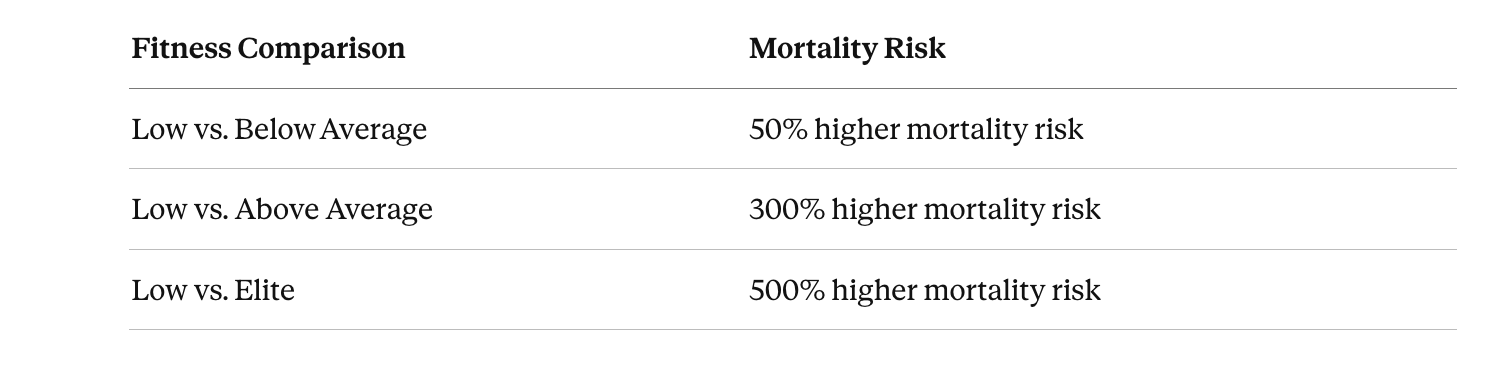
The relationship was dose-dependent. Every incremental improvement in fitness was associated with a measurable reduction in mortality risk. There was no plateau. Moving from below average to average fitness produced a significant survival benefit on its own.
The study also found that the mortality risk associated with low cardiorespiratory fitness exceeded the risk associated with smoking, diabetes, and coronary artery disease. Low fitness was, statistically, the most dangerous condition in the dataset.
Cholesterol, blood pressure, and glucose still matter. But cardiovascular fitness, the functional capacity of the engine, is the single most consequential variable in the longevity equation.
How VO2 Max Is Measured Clinically
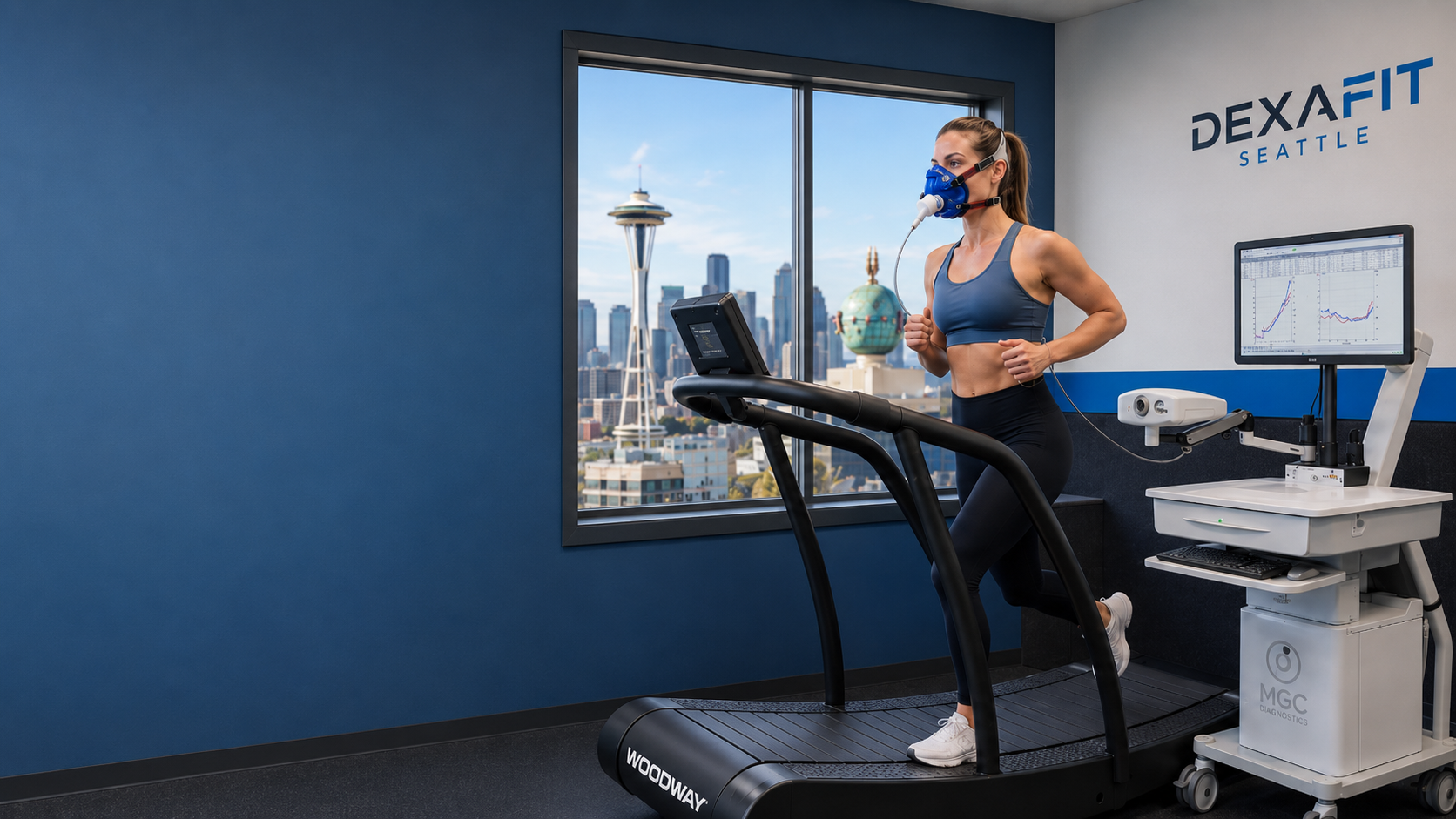
A clinical VO2 Max test uses a metabolic cart: a device that measures the volume and composition of inhaled and exhaled air in real time. The test subject wears a mask connected to the cart and performs graded exercise on a treadmill or cycle ergometer, with intensity increasing at regular intervals until volitional exhaustion.
The cart measures oxygen consumed (VO2) and carbon dioxide produced (VCO2) at each stage. From those measurements, several critical data points are derived.
Peak VO2 (VO2 Max) is the highest rate of oxygen consumption achieved during the test. This is the ceiling.
Aerobic Threshold (AeT) is the exercise intensity at which lactate begins to accumulate above resting levels. Below this threshold, the body is primarily burning fat. This is the upper boundary of Zone 2.
Anaerobic Threshold (AT) is the exercise intensity at which lactate accumulates faster than it can be cleared. Above this threshold, the body shifts predominantly to anaerobic metabolism. Sustained effort above AT is time-limited.
Respiratory Exchange Ratio (RER) is the ratio of CO2 produced to O2 consumed. An RER near 0.7 indicates predominantly fat oxidation; near 1.0 indicates predominantly carbohydrate oxidation. The RER curve across intensities reveals metabolic flexibility.
The entire test takes approximately 12 minutes. The output is a comprehensive map of your cardiovascular system: direct measurement of how your body processes oxygen under increasing demand, with training zones calibrated to your actual physiology.
The "220 Minus Age" Problem
Most people who train for cardiovascular health use the age-predicted maximum heart rate formula (220 minus age) to estimate their training zones. This formula was published in 1971, derived from a limited dataset that was never intended to serve as a universal standard.
Individual variation in maximum heart rate is enormous. Studies have documented standard deviations of 10–12 beats per minute around the predicted value. A 45-year-old with a predicted max heart rate of 175 could have an actual max anywhere from 155 to 195.
When the max heart rate estimate is wrong, every zone derived from it is wrong. Zone 2, the aerobic base-building zone that drives mitochondrial density, capillary development, and fat oxidation efficiency, could be off by 10–20 beats per minute. Training 15 beats below your actual Zone 2 produces minimal aerobic adaptation. Training 15 beats above it accumulates fatigue without building base.
A VO2 Max test eliminates this problem. It measures your actual thresholds and calibrates your training zones to your physiology, not a population average from 1971.
Training for Longevity: The Polarized Approach
The clinical and sports science literature converges on a training approach that maximizes cardiovascular adaptation: the polarized model.
Approximately 80% of cardiovascular training volume should target Zone 2 — sustained effort at or just below the aerobic threshold. This zone builds the aerobic base: mitochondrial density increases, capillary networks expand, stroke volume improves, and fat oxidation efficiency rises. These adaptations are the foundation of cardiovascular longevity.
The remaining 20% should target high-intensity work above the anaerobic threshold. This zone builds peak output capacity: the ability to sustain high-intensity effort and recover from it. Interval training, tempo work, and threshold efforts all live here.
The zone between AeT and AT is often called "no man's land" in the endurance literature, and for good reason — training predominantly here is the most common mistake among recreational exercisers who don't know their actual thresholds. It sits in an awkward middle position: intense enough to accumulate fatigue, but not structured enough to drive the specific adaptations that either Zone 2 or true high-intensity work produces.
That said, this zone has legitimate application in a well-designed program. Tempo work and sustained threshold efforts in this range drive meaningful gains in stroke volume: the amount of blood your heart ejects per beat, which is one of the primary mechanisms behind long-term cardiovascular efficiency. There is also a practical argument for athletes who have plateaued on a high-volume Zone 2 block: pushing into this zone deliberately, rather than drifting into it accidentally, can break through an aerobic ceiling that additional Zone 2 volume alone will not move. The distinction is intentionality. Landing here by default because you don't know where your thresholds are produces fatigue without adaptation. Targeting it with purpose, at the right point in a training cycle, produces a different outcome entirely.
A VO2 Max test identifies the exact heart rates that define each zone for your physiology. That precision is the difference between a training program that builds cardiovascular longevity and one that accumulates fatigue without meaningful adaptation.
VO2 Max as a Cylinder: The Cardiovascular Engine
Within the Longevity Engine™ framework, VO2 Max is the primary metric of the Cardiovascular cylinder, alongside aerobic and anaerobic thresholds, resting heart rate, and heart rate recovery.
The Cardiovascular cylinder determines the output capacity of the engine. When it is strong: high VO2 Max, wide threshold gap, efficient heart rate recovery, the engine sustains effort, recovers quickly, and supports the metabolic processes that keep the rest of the machine running. When it is the limiting cylinder, no amount of structural or metabolic optimization compensates for the constraint at the top.
Heart rate recovery (HRR) deserves specific attention here. The number of beats your heart rate drops in the two minutes following peak exertion is one of the strongest cardiovascular longevity markers available without a lab test. Poor HRR… a drop of fewer than 12 beats in the first minute, is associated with significantly elevated mortality risk. The Longevity Engine Read Tool includes HRR as a direct input because of its diagnostic weight.
The Bottom Line
VO2 Max is the ceiling on your cardiovascular system and the single strongest predictor of all-cause mortality in the clinical literature. It is measurable in 12 minutes. The test produces your peak number and the complete architecture of your cardiovascular system: thresholds, zones, efficiency, and the training prescription that follows directly from the data.
If you know your VO2 Max, enter it into the Longevity Engine Read Tool and see where your Cardiovascular cylinder stands. If you don't know it, the gap between your estimate and your actual number is exactly what a clinical test reveals.
Try the Longevity Engine Read Tool
Book your VO2 Max test at DexaFit Seattle / Renton
Frequently Asked Questions
What is VO2 Max?
VO2 Max is the maximum volume of oxygen your body can absorb, transport, and utilize during peak physical exertion. It is the gold standard measurement of cardiorespiratory fitness.
Why is VO2 Max the strongest predictor of longevity?
It reflects the integrated capacity of the pulmonary, cardiovascular, and muscular systems simultaneously. Large-scale studies have found that low cardiorespiratory fitness carries greater mortality risk than smoking, diabetes, or coronary artery disease.
How is VO2 Max tested?
A clinical VO2 Max test uses a metabolic cart to measure gas exchange in real time during graded exercise. The test takes approximately 12 minutes and produces your peak oxygen uptake, aerobic threshold, anaerobic threshold, and precise training zones.
What is a good VO2 Max?
VO2 Max varies by age and sex. For a 40-year-old male, values above 45 ml/kg/min are considered above average; above 52 is excellent. For a 40-year-old female, above 38 is above average; above 45 is excellent.
Can I improve my VO2 Max?
Yes. Consistent aerobic training — particularly Zone 2 work and high-intensity intervals — can improve VO2 Max by 10–20% in previously untrained individuals. Even trained athletes can achieve measurable improvements with threshold-specific programming.
Why is the "220 minus age" formula unreliable?
The formula was derived from a small, non-representative dataset in 1971. Individual variation in maximum heart rate can exceed 20 beats per minute from the predicted value, making zone estimates significantly inaccurate for a large portion of the population.
What is Zone 2 training and why does it matter?
Zone 2 is sustained effort at or just below the aerobic threshold. It builds mitochondrial density, capillary networks, and fat oxidation efficiency — the aerobic base that supports cardiovascular longevity.
What is heart rate recovery and why is it important?
Heart rate recovery (HRR) measures how many beats your heart rate drops in the minutes following peak exertion. Poor HRR is one of the strongest cardiovascular longevity markers available without a lab test, and is a direct input in the Longevity Engine Read Tool.
How does VO2 Max relate to the Longevity Engine™ framework?
VO2 Max is the primary metric of the Cardiovascular cylinder, which determines the output capacity of the engine. When the Cardiovascular cylinder is the limiting constraint, it restricts the performance of every other system regardless of how strong they are independently.
How often should I retest VO2 Max?
For most adults, retesting every 6–12 months provides sufficient data to track training adaptations and adjust programming. Active cardiovascular training programs may warrant retesting every 3–6 months.