Why You Crash at 2 PM: The Science of Metabolic Flexibility
Stop running your body on cheap fuel. It's time to build a Hybrid Engine.
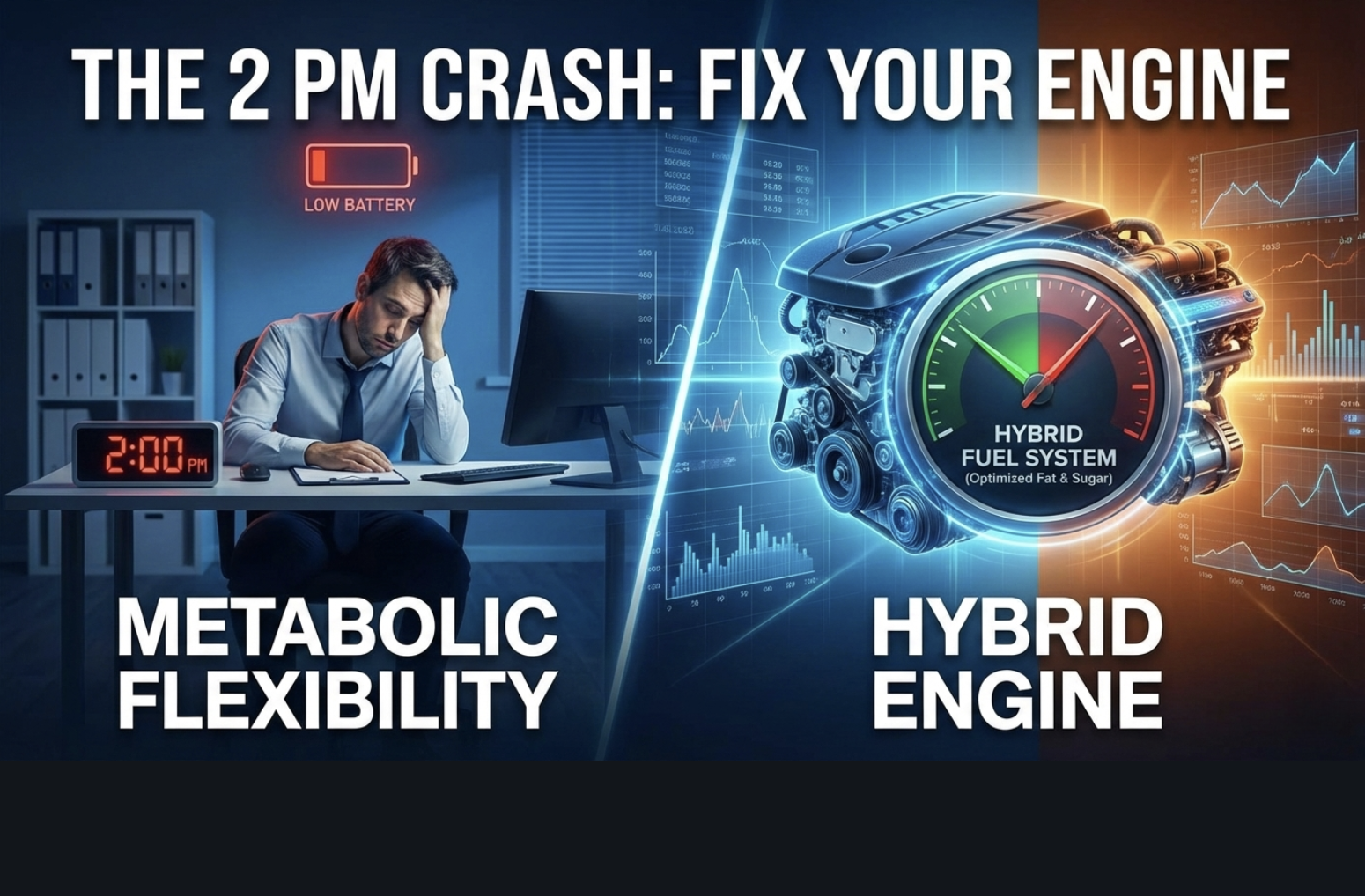
Are you a Gas Guzzler or a Hybrid? Your 2 PM crash is a fuel line problem, not a caffeine deficiency.
Living in Seattle, we run on caffeine. Between the grey skies and the tech grind, it’s easy to blame your afternoon slump on the weather or your workload. But that 2 PM fog isn't just 'Seattle Freeze'…
it's a fuel line problem.
The 'Gas Guzzler' Problem
Imagine you bought a high-end hybrid car. It has two fuel tanks:
1. A tiny gas tank (High octane, but runs out fast).
2. A massive electric battery (Efficient, lasts for days).
Now imagine you drove that car, but the software was broken. It refused to switch to the battery. You were forced to stop at the gas station every few hours to refill the tiny tank. If you missed a station, the car stalled immediately.
This is exactly how most people's metabolisms are functioning.
The Biological Reality: Understanding Metabolic Inflexibility
The human body is designed to be a Metabolically Flexible Hybrid Engine. You have two primary fuel sources:
Carbohydrates (The Gas Tank): Great for high-intensity bursts, but the storage capacity is small (glycogen).
Body Fat (The Electric Battery): A massive, slow-burning fuel source that can power you for days.
A healthy metabolism switches seamlessly between the two. You should burn fat while sitting at your desk, and switch to sugar only during a sprint or heavy lift.
However, most modern humans are Metabolically Inflexible. They are stuck in "Sugar Mode," relying entirely on glucose for energy. When blood sugar drops (typically around 2 PM), the engine stalls. You crash. You get "hangry." You feel the urgent need for a snack now.
This isn't just an energy problem. It is a heart health disaster.
The Heart Connection: Insulin Resistance & Visceral Fat
When your engine refuses to burn fat, that fuel has to go somewhere.
If you can't burn it, you store it. And you don't just store it on your hips; you store it in your blood (as Triglycerides) and around your organs (as Visceral Fat).
This leads to Insulin Resistance—the root cause of Type 2 Diabetes and a major driver of cardiovascular disease.
A metabolically flexible body clears fuel efficiently.
A metabolically inflexible body is constantly flooded with excess fuel it cannot process, creating inflammation.
This is why "Cardio" isn't just about burning calories. It's about teaching your engine to switch fuel sources.
The Protocol: How to Build a Hybrid Engine
You cannot "will" your body to burn fat. You have to train it. To do that, you need to stop guessing and start measuring.
At DexaFit, we use a data-driven, three-step protocol to restore metabolic flexibility:
1. Check the Exhaust (RMR Test)
We don't just measure how many calories you burn; we measure what kind of calories. Your Resting Metabolic Rate (RMR) test provides your RER Score (Respiratory Exchange Ratio).
RER 0.7: You are a Fat Burning Machine (Hybrid Mode).
RER 1.0: You are a Sugar Burner (Gas Only).
The Reality: Most people we test sit dangerously close to 1.0.
2. Train the Zone (VO₂ Max & Zone 2)
Once we know your baseline, we use your VO₂ Max data to find your exact Zone 2 Heart Rate. Zone 2 is the specific intensity where your mitochondria are forced to burn fat for fuel. It is the "software update" that teaches your body to access its battery backup.
3. Build the Tank (DEXA Scan)
Muscle is your body's primary "Glucose Sink." The more muscle you have, the more room you have to store carbohydrates without them turning into fat. A DEXA Scan ensures you are building the chassis (Lean Mass) to support your engine, rather than just losing weight.
The Takeaway
If you get anxious when you miss a meal, or if you hit a wall every afternoon, your engine is struggling. Stop treating the symptom with caffeine and sugar. Fix the engine.
Become a hybrid.
Frequently Asked Questions (FAQ)
What is metabolic flexibility?
Metabolic flexibility is the body's ability to efficiently switch between burning carbohydrates (glucose) for high-intensity activity and burning fat (lipids) for low-intensity activity or rest.
Why do I crash at 2 PM every day?
A 2 PM energy crash is often a sign of metabolic inflexibility or insulin resistance. It occurs when your blood sugar drops and your body cannot efficiently switch to burning stored body fat for energy.
What are the first signs of insulin resistance?
Beyond the "2 PM crash," early signs include increased belly fat (visceral fat), intense sugar cravings after meals, skin tags, and difficulty focusing. Biologically, a Resting Metabolic Rate (RMR) test showing an RER score above 0.85 at rest is a strong data-backed indicator.
How do I train my body to burn fat?
To train your body to burn fat, prioritize Zone 2 training (low-intensity, steady-state cardio) and increase muscle mass. Zone 2 training increases mitochondrial density, improving your ability to use fat as fuel.
Does Zone 2 training actually burn belly fat?
Yes. Zone 2 training is unique because it maximizes fat oxidation. While high-intensity interval training (HIIT) burns more calories total, it primarily burns glucose (sugar). Zone 2 specifically targets stored fat as fuel, making it highly effective for reducing visceral fat and improving metabolic health over time.
How long does it take to become metabolically flexible?
Most clients see changes in their energy levels within 4–6 weeks of consistent Zone 2 training and nutritional adjustments. However, fully "re-wiring" your metabolism to default to fat-burning mode (shifting your RER score from 1.0 down to 0.7) typically takes 3–6 months of dedicated protocol.
Can I fix my metabolism with diet alone?
Diet is half the equation, but it cannot increase your "engine size." You can starve a gas guzzler, but that doesn't turn it into a hybrid. To truly build a hybrid engine, you need the mechanical signal of exercise (to build muscle/storage) combined with nutritional control (to manage insulin).