The Female Longevity Exception: Why Women Need Different Data After 40
The longevity conversation was built by men, for men. It's time for a new paradigm.
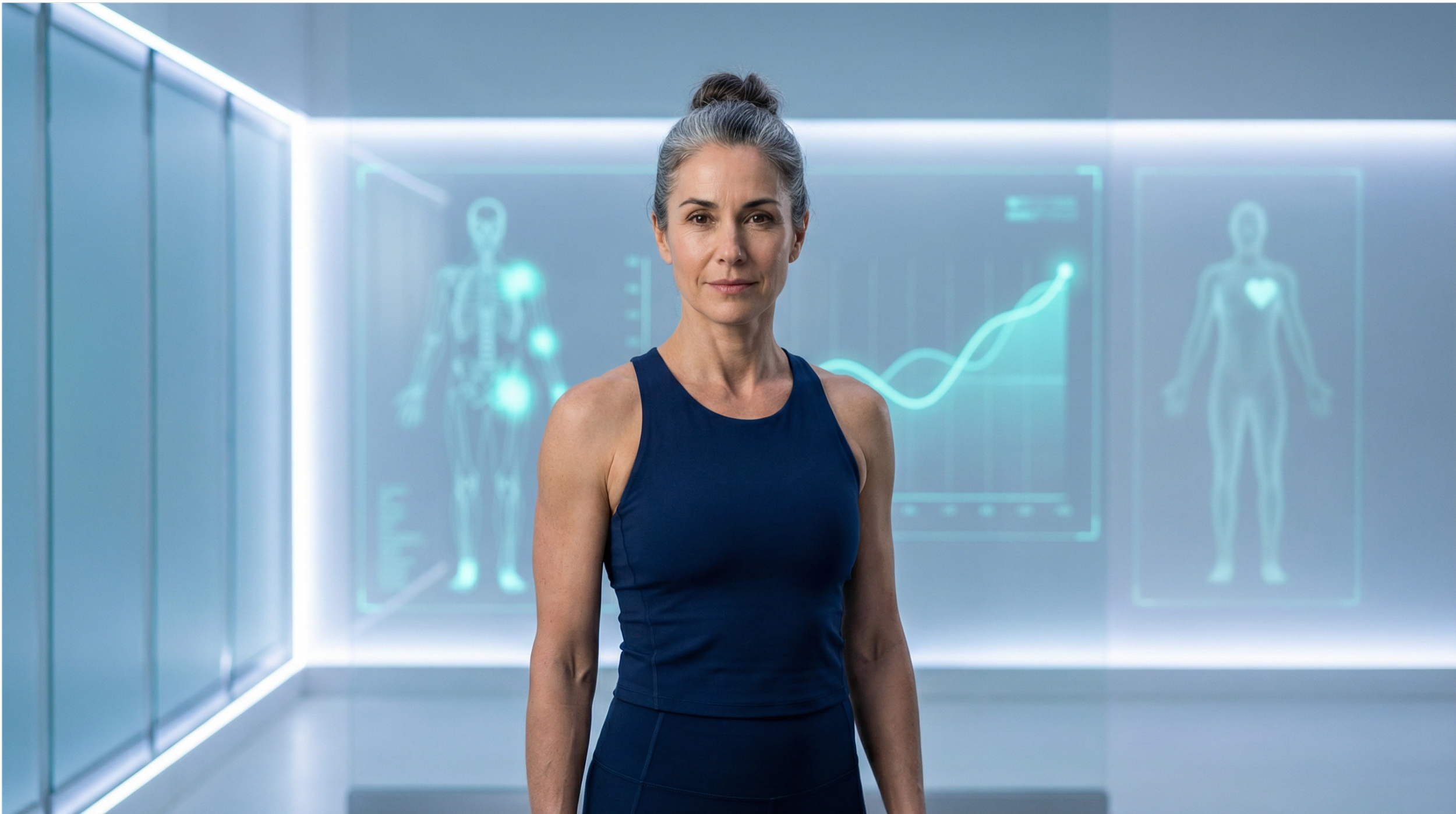
Women do not age like men. The female body operates on a completely different hormonal timeline… and the cliff is menopause.
The modern longevity conversation has a glaring blind spot. It is a narrative built primarily by men, researched on men, and designed for men. The prevailing wisdom, the biohacks, the fasting protocols, the training methodologies, all tacitly assume a male physiology as the default. This is not just an oversight. It is a fundamental flaw that fails millions of women who are trying to navigate their health in a system that was never built for them.
Women do not age like men. The female body operates on a completely different hormonal timeline, governed by a set of rules that the male-centric model simply ignores. For men, hormonal decline is a slow, linear process that unfolds over decades. For women, it is a cliff.
That cliff is menopause. It is not merely the cessation of menstrual cycles. It is a seismic and permanent shift in a woman's entire biological system. The decline of estrogen, the master regulator of female physiology, triggers a cascade of changes that renders the old advice of "eat less, exercise more" not just ineffective... but actively harmful.
The New Rules of Midlife Metabolism
Before menopause, estrogen is a woman's metabolic superpower. It helps sensitize cells to insulin, promotes the storage of fat in safer subcutaneous depots away from vital organs, and supports the maintenance of lean muscle mass. It is, in every meaningful sense, a protective force operating quietly in the background.
When estrogen declines, that protection disappears. And it doesn't disappear gradually. It drops off a cliff, and the body's entire metabolic priority list reshuffles almost overnight.
Muscle Becomes Expendable:
Without the estrogen signal, the body is far less inclined to build and maintain metabolically active muscle tissue. Sarcopenia, the progressive loss of muscle mass, accelerates sharply.
Fat Storage Shifts to Dangerous Zones:
The body begins to preferentially store fat in the abdominal region as visceral fat , the inflammatory fat that wraps around your organs and drives insulin resistance, cardiovascular risk, and metabolic disease.
Bones Become Vulnerable:
Estrogen is a critical guardian of bone density. Its absence accelerates bone loss at a rate that can take a woman from normal bone density to osteoporosis within a single decade, often without a single symptom until a fracture occurs.
Metabolism Slows Structurally:
The loss of muscle mass combined with hormonal shifts causes the resting metabolic rate to decline. The same calories that maintained weight at 38 now produce weight gain at 48… not because of a failure of willpower, but because the engine has changed.
Why Female-Specific Data is Non-Negotiable
To navigate this new terrain, women need a new map. Not a generic plan adapted from male research. Not population averages that mask what's actually happening in their specific body. Their own data, measured with clinical precision, interpreted through the lens of female physiology.
At DexaFit Seattle, three assessments form the foundation of what we call the Female Longevity Blueprint.
1. The Bone Density Baseline: DEXA Scan
This is the single most critical number a woman over 40 can know, and it is one that most women never learn until it's too late. You cannot feel your bones getting weaker. There are no symptoms of declining bone density. No pain, no warning light, no signal of any kind until a fracture occurs. A DEXA scan is the gold standard for measuring bone mineral density. It gives you your T-score and your Z-score — the numbers that tell you exactly where you stand.
2. The Body Composition Audit: DEXA Scan
The scale is a liar. It gives you one number that tells you almost nothing useful about your metabolic health. A DEXA scan provides an exact measurement of your lean mass, fat mass, visceral adipose tissue, and regional body composition. For a woman navigating the menopausal transition, these numbers tell a completely different story than the scale.
But structural integrity isn't just about bones. Kinetisense 3D Movement Analysis identifies the balance and postural shifts that occur as center-of-gravity changes during midlife. Meanwhile, Proteus Motion allows us to measure your power output—the 'zip' in your muscles that protects your joints, ensuring you're training for strength, not just survival.
3. The Metabolic Floor: RMR Test
The loss of muscle mass and hormonal shifts that accompany menopause cause a woman's resting metabolic rate to decline. This is not a permanent sentence. But it must be understood and accounted for. A Resting Metabolic Rate test tells you exactly how many calories your body is burning at rest… your metabolic floor. Eating below this number deprives the body of the resources it needs to repair tissue, synthesize protein, and support the very muscle mass that drives metabolic health.
The At-Home Female Longevity Audit
Audit Your Trajectory: 4 Signs You’ve Hit the "Cliff"
Before you book a clinical assessment, you can perform a self-audit to see how your biology is shifting. If you struggle with more than two of these, your "metabolic engine" and "chassis" need a data-driven intervention.
The "Skinny-Fat" Shift: Is your weight stable on the scale, but your waistline is expanding? This is a primary indicator of Visceral Fat accumulation and muscle loss.
The "Metabolic Floor" Fatigue: Are you eating less than ever but still gaining weight, or feeling "wired but tired"? You are likely eating below your RMR, forcing your body to cannibalize muscle for energy.
The Balance Baseline: Stand on one leg with your eyes open. Can you hold it for 30 seconds without wavering? Balance is the first thing to go as estrogen declines, affecting joint stability.
The Power Gap: Do you find yourself "heaving" out of a low chair rather than standing up effortlessly? This is a loss of Lower Body Power, a key predictor of future independence.
Ready to test your movement quality? > We have a full suite of movement screens you can do at home. Visit our Durability Decade Portal to access the 8-point movement audit and see how your chassis is holding up.
A New Conversation. A New Paradigm.
For too long, women have been told that the struggles of midlife are a personal failing. The data tells a different story entirely. It is not about a lack of effort. It is about a lack of the right information.
You are not broken. You are not failing. You are operating on a new set of biological instructions that the mainstream health conversation has been too slow to acknowledge. The solution is not to try harder with the old tools. It is to get new data and build a new map.
Your strongest decade may still be ahead of you. But it will be built on precision, not guesswork. On data, not deprivation. On understanding your biology and working with it, not against it.
Navigating your biological shift shouldn't be a guessing game. Below, we’ve answered the most common questions about the 'Menopause Cliff,' metabolic data, and how to audit your trajectory from home.
The "Female Longevity" FAQ
Q: Why does my weight stay the same but my clothes fit differently during perimenopause?
A: This is the "scale is a liar" phenomenon. As estrogen drops, you may be losing lean muscle (which is dense) and gaining visceral adipose tissue (abdominal fat). A DEXA scan is the only way to see this internal shift that a standard scale misses.
Q: Can I do the 10-Year Movement Audit at home?
A: Yes! You can start right now by using the 8-point movement screen found on our Durability Decade Portal. This is a great way to identify immediate "red flags" in your mobility and balance—two things that become critical as bone density changes during the menopause transition.
Q: What is Proteus Motion, and why is it in a longevity audit?
A: Strength is great, but power is the secret to independence. For women, power declines significantly faster than strength after 40. Proteus is the only tech that measures your power in 3D, telling us if your body has the "zip" required to protect your joints and prevent injury.
Q: Is it true that I should stop fasting during the menopausal transition?
A: The "male default" biohack of long-term fasting can actually spike cortisol in women, leading to further muscle wasting. Our RMR (Resting Metabolic Rate) test defines your metabolic floor, ensuring you are fueling enough to protect your muscle mass rather than starving it.
Q: How soon should I get a DEXA scan for bone density?
A: Waiting until age 65 (the standard recommendation) is often too late. We recommend a baseline scan at DexaFit Seattle by age 40-45. Knowing your T-score before the "menopause cliff" allows you to make the necessary resistance training and nutritional adjustments while you still have the hormonal runway to build bone.
Q: Can I regain muscle mass after menopause?
A: Absolutely. But it requires a pivot from "cardio-only" to high-quality resistance training. Using Proteus Motion in our lab, we can track your power and strength gains to ensure your protocol is actually working against the curve of sarcopenia.